
Cut the Clutter & Increase Focus
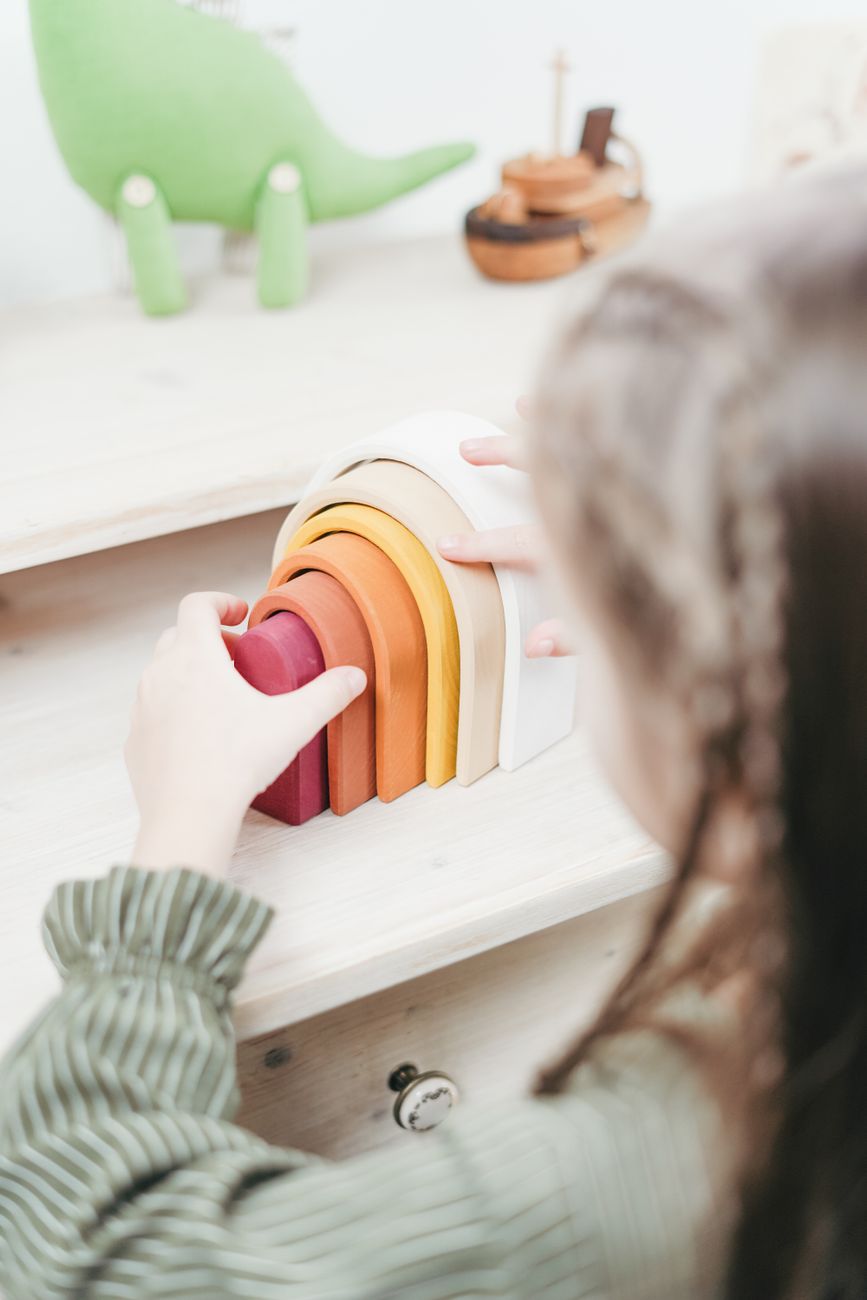
Most children either ignore toys when they’re stored in big toy boxes, or they’ll dump its contents out onto the floor and won’t focus meaningfully on anything. The issue isn’t the child, it’s the environment. Toy rotation fixes this. Instead of giving children access to every toy in the house, display a small, curated selection and store the rest. Every week or two, you swap items. Children play longer, focus more deeply, and returning toys get renewed interest.
A 2018 study in Infant Behavior and Development (Dauch et al.) found toddlers given 4 toys played longer and more creatively with each one than toddlers given 16. More toys didn’t mean richer play, it diluted it, echoing the “paradox of choice” seen in adults: too many options lead to shallow engagement and dissatisfaction.
Fewer toys also means every toy can actually have a home. With 60 toys, there’s no way each one gets its own defined spot that a child can access and return independently. But with a smaller set, everything has a place and the space stays organized and orderly. That order, in turn, invites your child to work longer and build their attention span.
And then there’s my favorite part: less stuff is easier to clean up. Some might even argue it becomes fun.
Remember, the more active the toy (automatic lights, sounds, movement) the less active the child. The less active the toy, the more active the child is. This might not mean no battery powered toys, but they should be the exception.
What you need
No new purchases required, just reorganize what you have:
- Open shelves your child can access independently. Budget-friendly options: IKEA KALLAX shelf on its side, a low bookshelf, a repurposed TV stand, stacked crates, or a single wall-mounted shelf.
- Ziploc bags, bins, and labels for storing toys.
- An area to store bins that is out of sight (closet, high shelf, under-bed)
- Your existing toys, sorted by category (sample list provided below)
- Enough trays to display toys on the shelf, and a couple smaller trays to hold loose parts within the trays.
Setting up the shelf
- Low: at or below your child’s eye level.
- Open: no doors or opaque bins, if they can’t see it, they won’t choose it
- Stable: anchored to the wall
Avoid giving your child access to a dump-everything toy box, or overly complicated origination systems you won’t keep up with. Focus on one-in-one-out: when a new item comes out, retire one from the shelf.
Keep it organized: each item should have its own tray and its own space on the shelf. All loose parts should be stored neatly on the tray. Displaying a toy partially or fully ‘undone’ (like an unstacked stacking toy) invites the child to complete it. Leave room to breathe. A shelf that’s 70% full looks inviting; 100% full looks overwhelming.
Sorting your toys
Pull everything out first. Then remove broken toys, missing pieces, dead-battery items, duplicates, and things your child never plays with. Donate or toss.
I recommend storing toys by category. It helps you easily swap out items (puzzles for puzzles or building toys for other building toys). It is a good way to identify areas that could use some additional pieces too for upcoming birthdays. Here is a list of categories:
- Fine motor (threading, puzzles, pegboards)
- Gross motor (balls, push/pull toys)
- Construction (blocks, magnetic tiles)
- Practical life (child-sized cleaning tools, dressing frames)
- Language (a basket with items that start with same letter (a rubber snake, a spoon, a real seashell or stone, felt strawberry)
- Math/logic (sorting sets, pattern blocks)
- Art (crayons, playdough, scissors)
- Sensory (texture boards, sensory bottles)
- Imaginative play (dolls, figurines, play food)
- Board books
When to rotate
Every 1–2 weeks. But watch your child instead of the calendar. Rotate when they ignore the shelf, disengage quickly, seem restless, or keep asking for stored toys. Hold off when they’re deeply engaged, discovering new ways to use a toy, working through a challenge, or returning to the same activity daily.
Try partial rotation: swap just 2–3 items at a time rather than the whole shelf. It’s less disruptive and shows you which specific changes reignite interest. And it’s quick.
Rotate while your child is asleep or out of the house, so they return to a “refreshed” shelf. Kids 3+ can help choose what comes out.
Common mistakes
- Engaging in power struggles over cleaning up and putting things away- Model how we take care of our things
- Rotating on a rigid schedule- follow engagement, not the calendar
- Overfilling the shelf- when in doubt, remove something
- Only rotating in favorites- aim for roughly 70% familiar, 30% new
- Not involving older kids- let them help choose and put away
- Not incorporating practical life activities. Practical life activities are real (not pretend) tasks drawn from everyday living like pouring water or sweeping up crumbs. This is the work they see the adults in their life doing, and toddlers naturally want to do them too. They give children a sense of purpose and competence while quietly building fine motor control, sequencing, and independence.
My practical life rotation list has included a measuring cup for filling the cat’s water bowl, a small watering can for the plants, a squirt bottle and rag for wiping windows, a folding board for towels, and a dustpan and brush.
All of these actives require a lesson on how to use it following the same format outlined below. You should almost always stay nearby while your child is learning. If your child starts squirting something other than the window, they’re showing you they’re not quite ready to use it independently. You can say, “You’re showing me you’re not ready to use the squirt bottle. We’ll try again later.” Then put it somewhere out of reach try again later that day, or the next. At that time say, “Remember, the squirt bottle is for windows only. Show me you can use it safely.”
Some families have more success keeping an item like the squirt bottle in sight but out of reach, so the child has to request it first, helping the parent to be ready to supervise. Even in my own classroom, across many years, I only ever needed to permanently remove one item from the shelf because a child couldn’t use it the way I’d asked. I hope that gives you confidence to try these things in your own home.
Remember: mistakes are learning opportunities, for both of you. If water spills on the way to the cat bowl, ask, “What do we do when we spill water?” — “Yes! Clean it up!” And now you’ve learned it is a good idea to keep a rag nearby, so your child can independently clean up and toss it in the hamper.
The bigger picture
Toy rotation reflects core Montessori ideas: a prepared environment where everything has a purpose, freedom within limits (full choice within a curated set), and respect for the child through a thoughtfully arranged space. It also trains you in observation, noticing what your child chooses, ignores, and lingers over, which is the foundation of the whole approach.
Teach your child to use trays and shelves
Introduce activities for your child’s shelf and model how to put things away when they’re done. Everything has a place.
Prepare in advance. For toddlers, mostly open-ended work is best, so your child can manipulate the materials independently. Have everything the activity needs ready on the tray before introducing it to your child, this way you won’t have to stop mid-lesson to go retrieve a missing piece.
Start with an invitation. Let your child know you have something to show them: “Would you like to see the ______ toy?” Say it with gentle excitement. If they show interest, show them where to sit, and let them know you’ll demonstrate first and then it will be their turn.
Demonstrate moving the toy. Slowly and carefully carry the work from the shelf to a table or the floor and place it where you want them to take it when they play. Show your child how to use the toy. Demonstrate slowly and carefully, using very few words, or none at all. Let your movements be the lesson.
Demonstrate clean-up. Show your child how to return the toy to the shelf. Most children will want to jump in right away, but if you can, help them wait until you. have completed the full cycle, including putting the toy back.
Invite your child to try. “Would you like a turn?” If they’d rather not, that’s okay, let them know: “That’s fine. The toy will be here when you want to try it.”
Let your child explore. Some children will want to play with the toy right there on the shelf. You can say, “You can take the tray to the table (or floor) first.” Observe without interrupting while they figure it out, unless they’re using it in an unsafe way. Skip “good job” and instead, describe what you see: “You put the green peg in the green hole,” or “You figured out which way the block goes.”
Remind your child to put it away. When they get up to leave, ask: “All done? Put it back on the shelf when you’re finished.” After a few lessons, you can shift to asking, “Where does that toy go when we’re all done?”
Long-term mastery of putting toys away
This takes years to build, and some adults still struggle with it. Don’t expect mastery any time soon. There will be days your child put things away easily, and other days they don’t. Support and encourage them either way.
If your child refuses to put a tray away, it’s fine to say, “Okay, I’ll put it away,” and simply model the care involved. Instead of asking “Can you put your toy away?” try, “Would you like to put it away yourself, or would you like my help?” If they want help, give them a specific, manageable task: “Can you pick up the puzzle pieces from the floor, and I’ll put the tray back on the shelf?”
There’s a natural tension between asking too much of a young child and doing something for them that they were capable of doing themselves. You won’t always get the balance right and that’s okay. Keep inviting, supporting, and encouraging, and trust your child to master this process when they’re ready.
Want more?
Check out The Montessori Toddler by Simone Davies and my short book review on it here.
Subscribe to have articles like this one sent right to your email (almost) every Friday.


Wish I had these tips back when mine were wee – and now I need an article about how to throw out all the mess of toys you’ve accumulated over 15 years of NOT doing the things in this article lol!
LikeLiked by 1 person
Haha!
LikeLike